Is AI
"conscious"?
Now we can measure it.
For the first time, functional consciousness has a number.
Everyone asks whether AI is "conscious". Almost nobody asks how to measure it. This paper proposes a tractable metric — the Functional Consciousness Score — grounded in information theory and benchmarked on real systems, from a Waymo self-driving taxi to the human mind. The results are both surprising and reassuring.
How conscious
is your AI system?
The Functional Consciousness Score measures a system's observable capacity
to access and reason about its own internal states — not what it "feels like" to be
that system, but what it can actually know about itself.
The results reveal a hierarchy with a clear message:
current AI systems, however powerful, are operating with a fraction of human
self-awareness. The gap is not philosophical — it is numerical.
FCS = R · P, where R (Representational Capacity) measures how richly a system models its own states, and P (Reasoning Power) measures how effectively it can reason over those models.
A map has rich spatial data but zero reasoning — it scores zero. A stateless LLM (ChatGPT, Claude, ...) has immense reasoning power but no persistent self-model — it also scores zero. Functional consciousness requires both.
The multiplicative structure is intentional: either dimension alone is insufficient. Only systems that combine rich self-representation with powerful inference achieve meaningful FC scores.
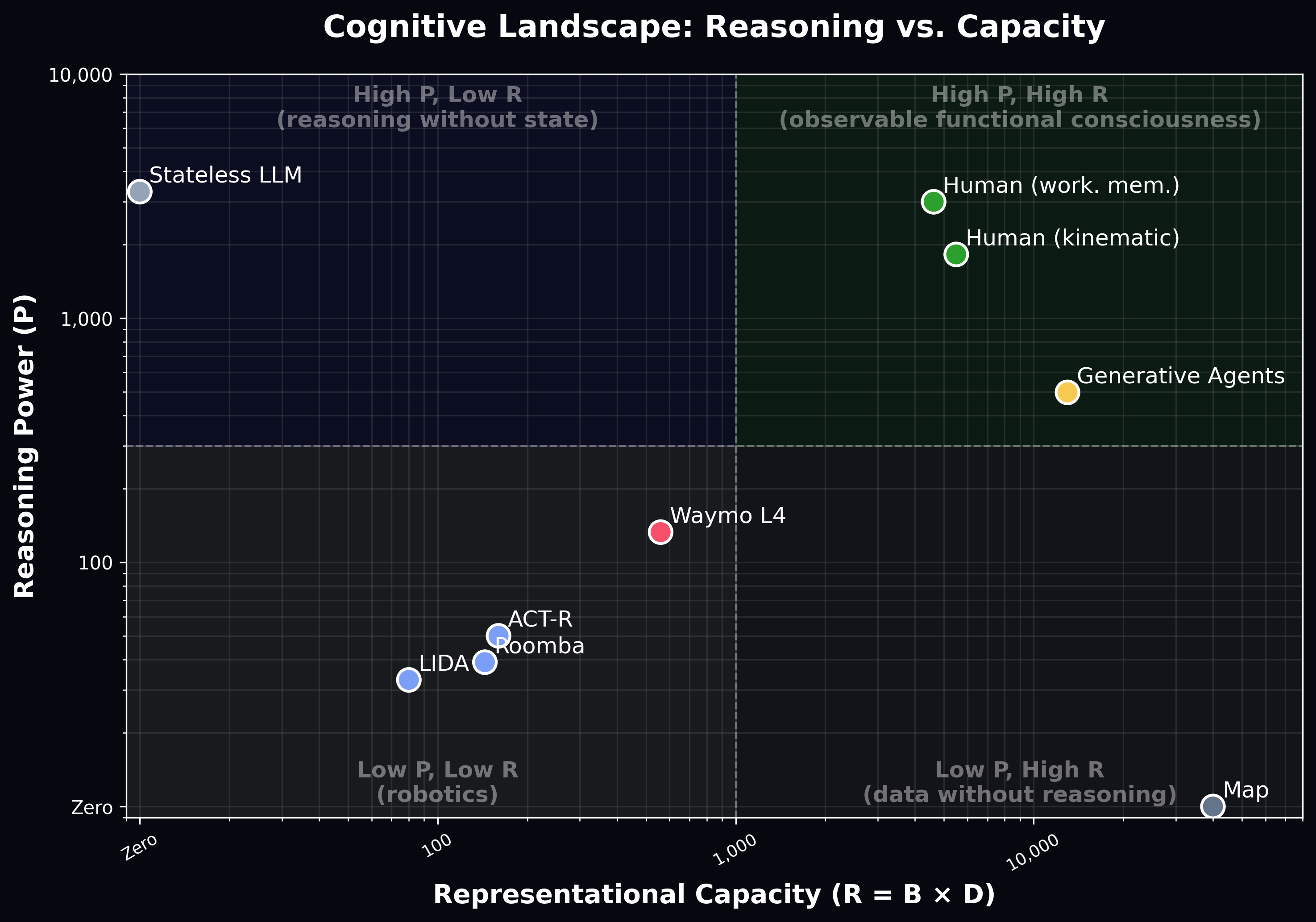
| System | B vars | D̄ bits/var | P reasoning | FCS score | Scale |
|---|---|---|---|---|---|
| ~1,000 | ~40 | 0 | 0 | ||
| 0 | 0 | ~3,300 | 0 | ||
| ~20 | ~4 | ~33 | ~2,600 | ||
| ~18 | ~8 | ~39 | ~5,600 | ||
| ~20 | ~8 | ~50 | ~8,000 | ||
| ~40 | ~14 | ~133 | ~74,500 | ||
| ~130 | ~100 | ~497 | ~6.5M | ||
| ~550 | ~10 | ~1,826 | ~10M | ||
| ~330 | ~14 | ~3,000 | ~13.9M |
Where does a system
know itself?
A single Functional Consciousness Score (FCS) tells you
how much functional consciousness a system has.
The cognitive shape tells you where.
We identified 46 distinct self-models across ten functional domains —
from body awareness and spatial reasoning to social understanding,
ethical self-monitoring, and meta-reflection.
Plotting a system's coverage against the human baseline reveals its unique cognitive
fingerprint.
The ten domains were derived from a bottom-up analysis of Virginia Woolf's stream-of-consciousness prose — a dataset uniquely dense in first-person self-reference — using a methodology called Functional Self-Model Analysis (FSMA).
FSMA asks: what internal models must a system possess to consistently produce a given output? If a system reliably describes its own emotional state, it must functionally model that state — regardless of whether it "feels" anything.
Functional Consciousness & the Five Theories
Hover a petal to explore the overlap
Functional Consciousness
A measurable architectural property: the capacity to access and reason about internal reasonings of one's own states.
The five petal theories each overlap with FC's core properties (shown in the concentric rings). Hover any petal to see what FC covers — and what lies beyond its scope.
Each petal blooms where theory meets FC · The center shows FC's core functional properties
Common Questions
What is "consciousness"? How is our answer different from previous answers?
Consciousness has two faces. One is the inner felt quality of experience — what it's like to see red, feel pain, or notice your own thoughts. This is the "hard problem", and nobody has solved it. The other is the functional capacity to access and reason about your own internal states — to know what you know, notice what you don't know, and use that self-knowledge to act. This second face is what FC measures.
Previous theories each captured important pieces but couldn't produce numbers you could calculate for real systems. FC sets aside the "hard problem" entirely and focuses on what can actually be measured. The result is a metric that produces real numbers for real systems and lets you compare them on a common scale.
Read longer discussion →What does FC mean for my job — can AI really replace human thinking?
FC-enhancement makes AI better at knowing what it doesn't know — which is genuinely useful and genuinely changes the risk profile for some professional roles. But the cognitive shape charts show something reassuring: the domains where humans are most distinctively human — emotional depth, social trust, ethical judgment, embodied presence — are precisely the domains where even the most advanced AI systems remain far behind. The gap is not closing as fast as the headlines suggest, and FC gives us a way to measure exactly how far it still is.
Read longer discussion →Will FC optimization accelerate AGI?
Yes, but in a more controlled and potentially safer way than the current trajectory — and FC optimization might actually be one of the few paths toward AGI that doesn't end badly.
FC-optimized systems would be more capable of the kind of self-monitoring that makes any intelligent system — human or artificial — less dangerous. A mind that knows its own limitations, tracks its own reasoning errors, and has functional representations of its own ethical constraints is structurally safer than one that doesn't, regardless of raw capability. Whether this accelerates or decelerates the path to AGI depends on choices humans make about what to optimize for. FC gives us better instruments for those choices. It doesn't make the choices for us.
Read longer discussion →Do "dhyana" meditation states falsify FC — or illuminate it?
Advanced dhyana meditation states present a serious phenomenological challenge to FC. As practitioners progress through the dhyana sequence, self-models progressively dissolve (inner voice, body sensations, narrative self) while the experience is reported as becoming "more conscious". If accurate, this contradicts FC's core claim that functional consciousness tracks self-modeling capacity. But there are several FC-compatible interpretations worth taking seriously, and the question may ultimately turn on whether these states involve genuine increases in phenomenal consciousness or a distinctive "attractor state" that feels maximally conscious for other reasons. This remains an open empirical question — and an unusually interesting one.
Read longer discussion →Can FC improve AI safety and transparency?
FC reframes alignment as a representational problem. While current safety techniques (like RLHF or scalable oversight) often become brittle as models scale, FC-based metrics measure a system's self-model fidelity (R) and reasoning power (P). Because P grows with capability, highly capable systems with accurate self-models become more reliably transparent and capable of autonomous oversight without external human intervention.
- The AI safety landscape
- Current alignment techniques
- What FC adds
- Techniques that grow with the model
- Oversight-free safety mechanisms
- Techniques that survive model self-knowledge
Why "consciousness" and not "self-modeling score"?
Because the math forced our hand. We started with something modest "the observable capacity of a system to reason about its own states". Then FC turned out to operationalize Higher-Order Thought theory (a state contributes to FCS if and only if it's HOT-conscious), yield a computable analogue of IIT's Φ, require Global Workspace Theory-style availability by definition, need an Attention Schema Theory-style filter, and ground representational capacity in predictive mutual information in line with Predictive Processing. Five independent convergences, none of them planned.
Read longer discussion →What are the main challenges and open difficulties for Functional Consciousness?
FC trades one set of hard problems for another. It sidesteps the metaphysical implications and the mathematical intractability of theories like IIT by anchoring on observable behavior and information theory, but this move introduces its own measurement difficulties: how to correctly and completely identify a system's self-models, how to draw clean boundaries between them, and how to distinguish reasoning outputs that genuinely predict the future from outputs that merely look like reasoning. These are hard problems, but they are engineering problems rather than conceptual dead ends, and several of them have principled partial solutions. Ongoing revisions and technical issues are tracked on the Updates & Errata page.
Read longer discussion →How does FC relate to the "Big Five" theories of consciousness?
FC was not designed to compete with or replace IIT, GWT, HOT, PP, or AST. It was designed to produce a "consciousness meter" for real systems. However, we discovered during the process that FC captures core tenets of all five theories — while deliberately leaving their metaphysical superstructure untouched. For each theory, there is a part FC covers and a part that sticks out beyond FC's scope.
Read longer discussion →Does FC operationalize Higher-Order Thought (HOT)?
Yes — and it's the cleanest correspondence in the paper.
HOT says a state is conscious when it becomes the target of a higher-order representation available to the system's reasoning. FC's Definition 2 requires exactly that: a self-model variable mᵢ represents internal state sᵢ and must be available to global reasoning. Under mild assumptions, a state contributes to FCS > 0 if and only if it is HOT-conscious — making FC a quantitative formalization of HOT's binary criterion. It even naturally handles recursive "thoughts about thoughts" through meta-cognitive self-models, explaining why our introspection is finite rather than an infinite regress. HOT tells you which states are conscious; FC tells you how much.
Read longer discussion →How does FC relate to IIT?
FC and IIT share the intuition that consciousness requires both differentiation (rich internal representations) and integration (those representations working together). In FC, differentiation maps onto R and integration onto P — specifically, how much reasoning power depends on self-models being cross-linked across subsystems.
FC defines a computable analogue of IIT's Φ:
Φ_FCS = P(S) − Σⱼ P(moduleⱼ)
Unlike IIT's Φ, which is computationally intractable, Φ_FCS is directly computable for white-box systems. FC captures IIT's core functional intuition in a tractable form without inheriting its metaphysical overhead.
Read longer discussion →Scott Aaronson defined the "Pretty Hard Problem of Consciousness" and showed that IIT fails to solve it. Does FC succeed where IIT failed?
We believe yes. FC produces actual numbers, grounded in predictive mutual information and reasoning power of self-models, demonstrated by scoring 9 agents on a common scale. Aaronson's counterexamples all share a property: they integrate information without representing themselves. A Vandermonde matrix transforms inputs to outputs with maximal integration, but has no model of its own states — so FC correctly scores it at zero. The cost: FC trades IIT's intractability for a new problem — enumerating all self-models of a system correctly and completely.
Read longer discussion →How does FC relate to the Butlin et al. "Consciousness Indicators" paper?
Butlin, Long, Chalmers et al. (2025) ask: which architectural features should we look for when assessing whether an AI system has phenomenal consciousness — whether there is something it is like to be that system? FC asks a different but related question: how much functional consciousness does a system have — meaning its observable capacity to access and reason about its own internal states? These are not the same question, and FC does not claim to answer Butlin et al.'s.
What FC does offer is a single unified formula that covers eleven of the fourteen indicator Butlin et al. identify — with three principled exceptions FC acknowledges openly, two of which are directly tied to the phenomenal/functional gap. FC can be read as a tractable implementation of the functional substrate that Butlin et al.'s indicator method is trying to triangulate — without making the phenomenal claims their framework ultimately targets.
Read longer discussion →How does FC relate to the Lopez & Wiese building block approach?
Lopez and Wiese (2025) propose a methodological shift in consciousness science: stop competing over which full theory is correct, and instead identify the foundational building blocks that any adequate theory must contain. FC makes a different but complementary methodological shift: stop debating whether a system is conscious, and instead measure how much of the necessary functional substrate it has. Neither paper knew about the other's move. When placed side by side, they converge — which is the interesting observation.
Read longer discussion →